Cell Signaling
Cell signaling technology describes the communication systems within and between cells which govern and coordinate cell activities. Understanding more about cell signaling has relevance to all biological sciences and medicine in understanding how living organisms function in health and disease. This understanding can also enable intervention, for example, in the design of drugs to prevent disease and the exploitation of biochemical pathways, for example, in biosensors in industrial applications.
Fluorescence microscopes and especially confocal fluorescence imaging, optical sectioning and 3-D reconstruction are powerful techniques that allow researchers to look into cells and tissues to identify and locate molecules of interest in and between cells. Fluorescent probes such as the genetically encoded GFP family and chemical probes are central to the observation of molecules /ions of interest.
Live cell imaging allows signaling events to be observed directly and over extended periods of time, giving researchers temporal and spatial continuity in event monitoring. The development of the GFP family of fluorescent probes allows monitoring of protein expression, locating and tracking molecules and identification of intermolecular interactions. GFPs fused to a calcium binding protein can also be used to visualize calcium signaling events central to many cell communication events. Key imaging techniques include multiphoton uncaging, FRET, FLIM, TIRF, FRAP, FLIP and BRET. Multiple probes may be used simultaneously and identified with high resolution using spectral imaging capabilities.
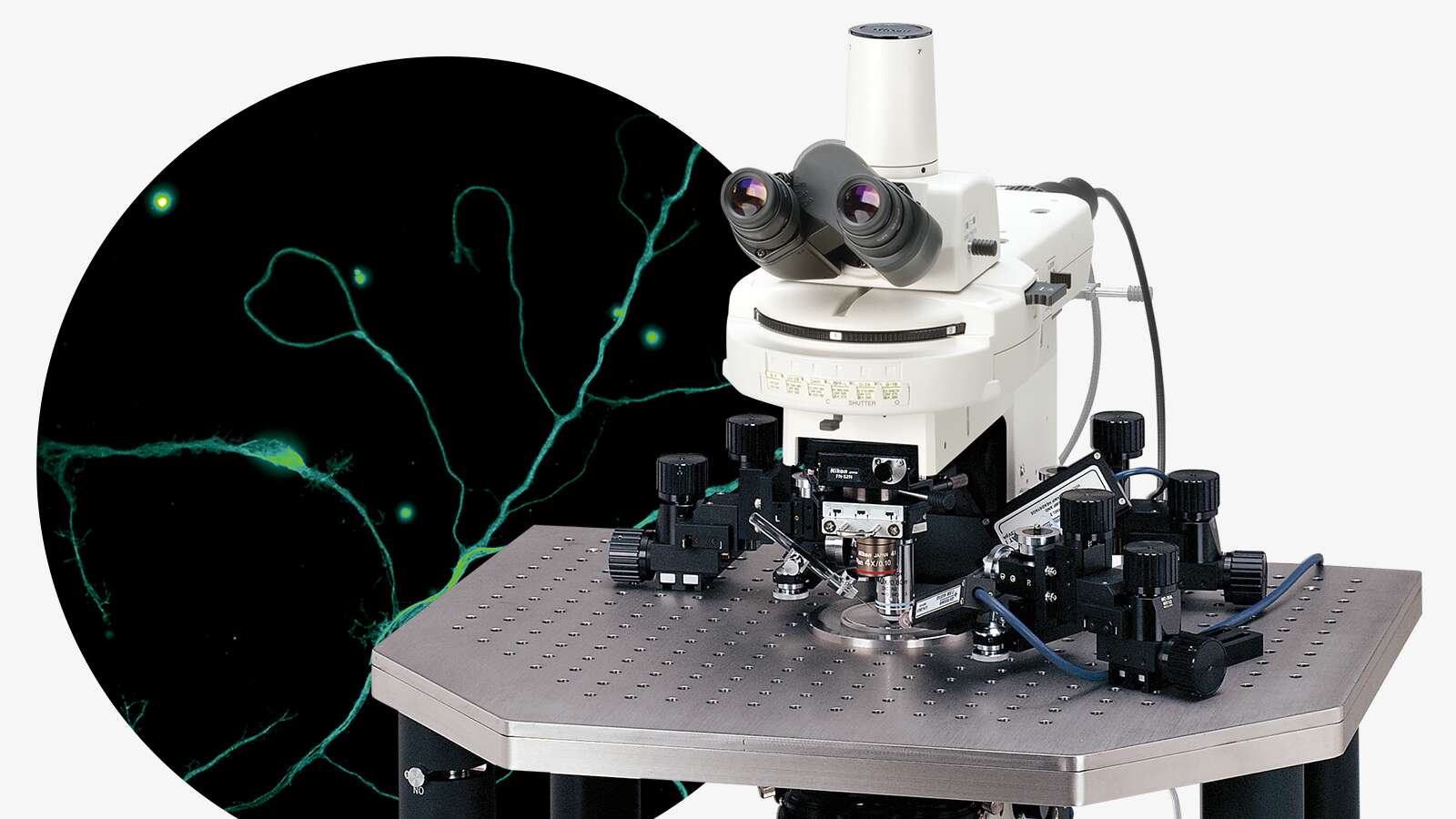
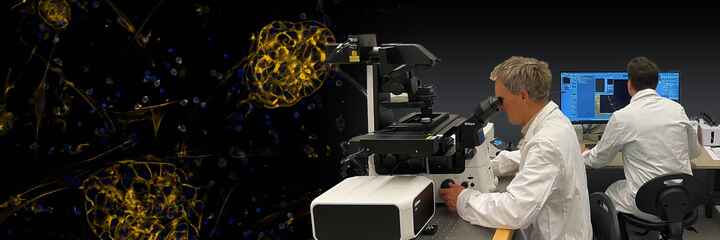
Image Credit: Fixed Neuronal Cells of Mouse Brain Expressing eGFP. Dr Satoru Kondo. Department of Cellular Neurobiology, Graduate School of Medicine, University of Tokyo
Associated Products
-
A1R MP Multiphoton Confocal
Powerful multiphoton and confocal microscope system offering high speed, high resolution and high sensitivity multiphoton excitation and confocal fluorescence i...
-
A1 MP Multiphoton Confocal
Nikon’s A1 MP is a streamlined version of the unique A1R MP multiphoton imaging system developed for simplified, cost-effective multiphoton imaging.
-
A1R-A1 Confocal
Nikon’s groundbreaking confocal imaging system offering greater speed, higher resolution and unprecedented system flexibility.
Palaeontology, Neurobiology, Biophysics, Molecular Pathology, ADME Tox…
-
Eclipse Ti
Advanced inverted microscope systems offering unprecedented functionality, including built-in Perfect Focus and high-speed motorization.
Neurobiology, Molecular Pathology, ADME Tox, Cell Culture, Target Identification…
-
Eclipse C1 Plus Confocal
Modular confocal microscope system with superior scan head optics, faster image acquisition capabilities and improved control over microscope illumination intens...
Palaeontology, Neurobiology, Molecular Pathology, Marine Biology, Developmental Biology…
-
AZ100 Multizoom
A new zoom microscope solution for macro imaging applications for biomedical and industrial markets.
Rocks/Minerals, Fabrics/Textiles, Lab-on-a-Chip, Palaeontology, Neurobiology…
-
N-SIM Super-Resolution
New Super-Resolution microscope which exceeds the traditional diffraction limits by two times.